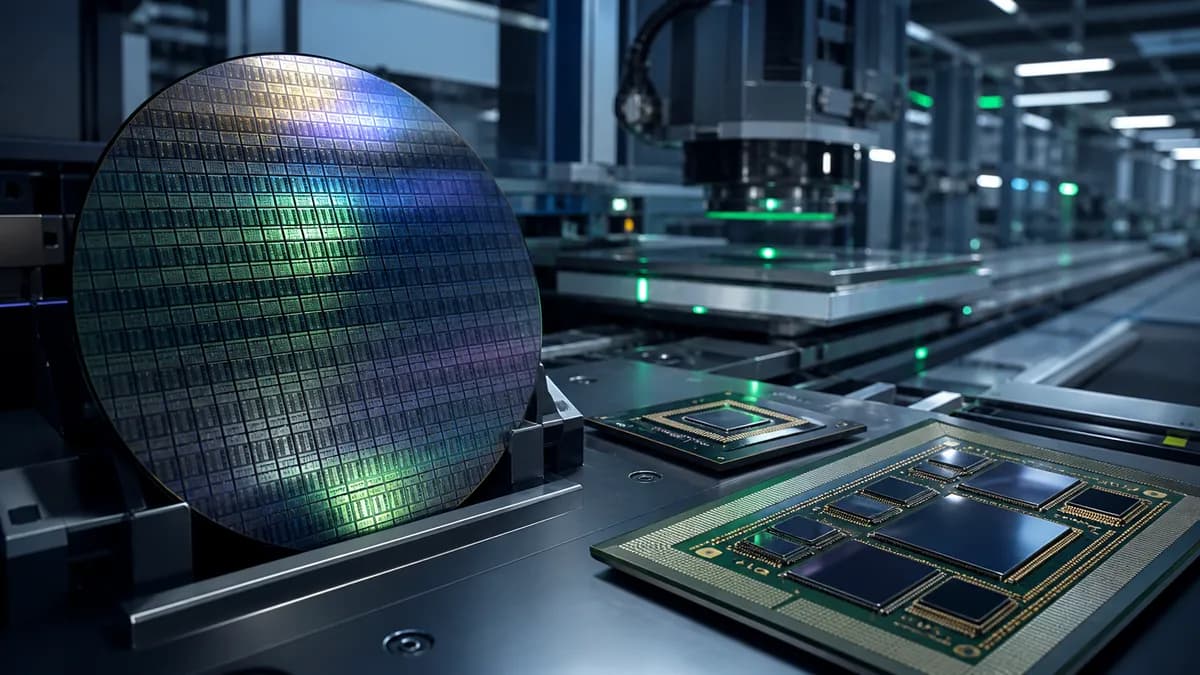
A procurement-focused examination of advanced-node wafer economics, CoWoS bottlenecks, architectural diversification, and resilient CPU sourcing.
Supply Chain Constraints and Bottlenecks
An analysis of the four rigid constraints affecting high-performance CPU supply—spanning wafer fabrication processes, geographic clusters, and packaging & testing.
Hard Cost Constraints: No Cheap Alternatives for Advanced Process Nodes
The price of a single 3nm wafer has surpassed $20,000, signaling that advanced process nodes have officially entered the "physical limit cost zone." This premium is not merely a profit grab by foundries; it represents unavoidable expenditures driven by extremely expensive production assets and razor-thin margins for error.
ASML lithography systems form the cornerstone of this cost structure. At the 3nm node, a single chip requires multiple EUV (Extreme Ultraviolet) exposure steps, with each step entailing the amortization of massive equipment depreciation costs. Currently, the price of a single High-NA EUV lithography machine approaches $400 million. To maintain gross margins, foundries must pass these capital expenditures directly onto the unit price of the wafers.
The logic behind R&D cost amortization is also undergoing a radical shift. The initial investment to design a CPU using advanced process nodes typically runs into the hundreds of millions of dollars, covering EDA tool licensing, complex IP fees paid to companies like Synopsys or Cadence, and the expenses of massive engineering teams. Consequently, unless shipment volumes reach the tens or even hundreds of millions, the R&D cost allocated to each chip becomes prohibitively high for small- and medium-sized OEMs. In the realm of advanced process nodes, the cost-diluting effect of economies of scale is weakening; the yield ramp-up period for each successive process generation is lengthening, and the loss of defective wafers during the initial phase effectively locks in a high price floor.
Geographic Landscape: Capacity Synergy and Disparities from Hsinchu to Zhangjiang
The physical flow of the global semiconductor supply chain follows strict clustering logic. The Taiwan cluster—centered around the Hsinchu Science Park—commands the vast majority of the global market share for contract manufacturing at advanced nodes (7nm and below). TSMC’s presence has established Taiwan as the "home port" for global high-performance CPU production. Any global supply fluctuation can ultimately be traced back to capacity allocation priorities within this narrow strip of territory. The Yangtze River Delta cluster exhibits a complementary positioning. Centered on Shanghai’s Zhangjiang Hi-Tech Park, the region has developed China’s most comprehensive semiconductor industry chain. Breakthroughs by companies like SMIC in mature nodes and specialized processes have enabled them to handle significant manufacturing demand for peripheral chips (such as power management and interface controllers). While there is still room to catch up at cutting-edge nodes like 3nm, the Yangtze River Delta has become an indispensable global buffer zone thanks to its strengths in design tool support, mid-stage manufacturing, and a complete supporting supply chain.
The Pearl River Delta cluster, meanwhile, acts as an "application converter." Shenzhen and Guangzhou host a vast number of end-product OEMs that rapidly transform wafers produced in Hsinchu and designs created in Zhangjiang into consumer electronics. This physical flow—design in Zhangjiang, manufacturing in Hsinchu, and application in the Pearl River Delta—forms the fundamental character of the industry chain. Production synergy relies on a clear division of labor, while the "misalignment" stems from the tension between the extreme concentration of advanced process capabilities and the highly fragmented nature of application-level demands.
Packaging and Testing Bottlenecks: How Overlooked CoWoS Capacity Determines Delivery Priorities
In the era of advanced process nodes, a wafer rolling off the production line does not signify the completion of manufacturing. A shortage of CoWoS (Chip on Wafer on Substrate) advanced packaging capacity has become a critical bottleneck for the supply of high-performance CPUs. Historically, packaging and testing were viewed merely as "back-end services" at the tail end of the supply chain; however, with the rise of Chiplet technology, the status of this segment has undergone a fundamental shift.
CoWoS packaging enables the integration of chiplets from different process nodes, thereby alleviating reliance on a single, costly advanced process. Yet, the process is incredibly complex, demanding levels of precision and yield comparable to wafer fabrication. Currently, global high-performance CoWoS capacity is heavily concentrated among a few leading manufacturers; consequently, even if a foundry completes 3nm wafer fabrication, chips may still fail to meet delivery deadlines due to queues for packaging.
Packaging and testing costs now account for 10%–20% of the total cost of advanced-node chips, a significant increase from the single-digit percentages seen in traditional models. Domestic giants like JCET and Tongfu Microelectronics are accelerating the deployment of advanced packaging lines, aiming to secure a foothold in the high-value Chiplet ecosystem. The criteria for determining delivery priorities are shifting from "who can secure wafers" to "who can grab CoWoS packaging slots."
Equipment Transmission: The "Pulse Effect" of ASML Delivery Cycles on Foundry Capacity Expansion
A foundry's capacity ceiling is effectively locked in by the delivery schedules of upstream equipment manufacturers. The delivery lead times for ASML’s lithography systems, etching machines, and thin-film deposition equipment directly determine the upper limit of capacity supply for the next 24 months. Because high-performance consumer CPUs rely heavily on EUV lithography, ASML’s production cadence acts as the "metronome" for the entire industry supply chain.
When ASML’s delivery cycles lengthen, foundry expansion plans experience a distinct "pulse effect": capacity is suddenly unleashed at a specific point after equipment arrival, yet the market suffers from prolonged supply tightness during the intervening periods of equipment scarcity. This discontinuous capacity ramp-up means that CPU procurement contracts often require capacity to be reserved one to two years in advance. The bargaining power held by equipment manufacturers is indirectly driving up foundry prices; to hedge against the uncertainties of equipment procurement, foundries tend to incorporate more "guaranteed minimum" clauses into contracts, ultimately creating a rigid cost floor.
Architectural Diversification: A Bargaining Lever to Break the Invisible Monopoly
From the lock-in of x86 and ARM to the rise of RISC-V: how buyers can regain bargaining power through architectural decoupling.
The Cost of Bargaining Weakness: The Invisible Price of Single-Architecture Dependency
The passive position of buyers within the x86 ecosystem stems from the deep technological lock-in established by Intel and AMD. In PC and server tenders, these two giants not only control processor pricing but also deeply influence OEM financial models through rebate programs and Market Development Funds (MDF). This duopoly leaves buyers with almost no room to deconstruct Bill of Materials (BOM) costs during negotiations. Once a product design is locked into the x86 instruction set, subsequent upgrades and maintenance inevitably fall into the suppliers' tiered pricing traps.
The introduction of the ARM V9 architecture was intended to break this stalemate, yet its complex licensing agreements have introduced new compliance costs. ARMv9 involves not only per-unit royalties but also a series of restrictive clauses tailored to specific application scenarios. For Chinese manufacturers, the long-term stability of these licensing agreements remains uncertain. Relying solely on ARM or x86 means that a company's supply chain resilience hinges entirely on the supplier's compliance reviews and export licenses. This relationship of "technological parasitism" leaves buyers with virtually no recourse other than to accept price hikes when they occur.
The goal of an architecture decoupling strategy is not total replacement, but rather the dilution of Tier 1 suppliers' pricing power through the introduction of competitors.
Architecture Decoupling: How RISC-V Moves from the Lab to the Procurement List
The commercial value of RISC-V is shifting from "open-source idealism" to "bargaining leverage." In sectors such as embedded controllers, IoT modules, and low-power edge computing, solutions from companies like StarFive and T-Head have demonstrated RISC-V's cost advantages. Eliminating expensive instruction set licensing fees can reduce the IP cost per chip by more than 20%. Even more significant is the fact that when buyers list RISC-V as an optional architecture in their tenders, suppliers within the ARM ecosystem—previously unyielding—often voluntarily lower their price quotes.
The pace of software ecosystem adaptation is the critical variable determining the cost of switching architectures. Support for RISC-V within the Linux kernel and mainstream compilers has now matured. Savvy procurement decision-makers no longer wait for a perfect ecosystem; instead, they adopt a "phased replacement" strategy. They introduce RISC-V first in areas with lower ecosystem dependency—such as non-core logic control and human-machine interfaces—using this as leverage to negotiate better terms with mainstream suppliers.
A Shift in Power: When OEMs Begin Defining Chip Specifications
The emergence of the Qualcomm Snapdragon X Elite marks a redistribution of power within computing platforms. For a long time, the PC... While traditional OEMs were once limited to selecting from specifications provided by Intel, Apple demonstrated—through its in-house M-series chips—the high profit margins and product differentiation that come with "architectural autonomy." Now, OEMs like Lenovo and Dell are attempting to intervene in the "P0" (initial definition) stage of chip development through deep customization or even by developing their own functional modules.
This shift transforms supply chain logic from "buying products" to "buying architectures." When OEMs can define chip specifications, they gain the power to mix and match capabilities from foundries and IP suppliers. Architectural diversification is no longer merely a safeguard against supply disruptions; it is a strategy to escape the price wars caused by commoditization through differentiated hardware performance. By introducing ARM-based PC processors into their product lines, buyers have successfully breached the traditional x86 stronghold, forcing Intel to accelerate process node iterations and adjust its long-held, arrogant pricing strategy.
Policy Dividends: Bargaining Leverage for "Xinchuang" CPUs in Specific Markets
Policy incentives for "Xinchuang" (IT innovation and localization) have created a unique window for the large-scale procurement of domestic CPUs. In sectors such as government administration, finance, and critical infrastructure, procurement volumes for Loongson and Phytium chips have surpassed the break-even point, directly driving a rapid decline in per-unit costs. Loongson’s autonomy—rooted in its proprietary LoongArch architecture—offers buyers a safe haven completely independent of external licensing frameworks.
Domestic CPUs are seeking opportunities to penetrate the non-Xinchuang consumer market by offering "performance-equivalent alternatives." In scenarios such as educational PCs and self-service kiosks, solutions from Phytium or Zhaoxin offer competitive Total Cost of Ownership (TCO) while meeting basic computing requirements. Buyers should leverage this policy window to establish a backup supply system for domestic CPUs. This serves not only compliance needs but also ensures the availability of a "second-source" solution ready for mass production should supplies of mainstream architectures face volatility. This cross-architecture substitution capability represents the ultimate bargaining leverage for buyers in extreme market conditions.
Supply Chain Resilience: A Strategic Shift from JIT to JIC
How leading OEMs are reshaping chip procurement resilience through N-tier supply chain management, agile design, and risk hedging.
JIT (Just-In-Time)
Just-In-Time (JIT) Production
This approach pursues zero inventory to maximize capital efficiency. However, in an environment of supply volatility, it easily leads to production disruptions, becoming a killer of corporate gross margins.
JIC (Just-In-Case)
Just-In-Case
This involves establishing strategic inventory, using the cost of capital to hedge against capacity risks. The core principle is tiered stocking—rather than blind hoarding—to ensure supply chain resilience.
Strategic Inventory: Redefining Safety Boundaries in the JIC Model
CPUs depreciate rapidly; excess inventory can quickly turn into asset impairment. We recommend categorizing procurement lists into three tiers: for mature architectures nearing the end of their lifecycle, inventory levels should be capped at four weeks; conversely, for advanced 3nm or 5nm chips currently ramping up production, safety stock must be extended to 12–16 weeks. This tiered stocking logic essentially uses the cost of capital to hedge against the risk of low priority in capacity allocation.
Establishing a hardware performance contingency plan based on cloud-based VDI solutions is currently the most effective defensive strategy. When high-performance physical CPUs face supply shortages or exorbitant prices, companies can maintain product delivery without altering motherboard hardware by equipping endpoints with low-power, low-cost domestic SoCs and leveraging cloud computing power to bridge the performance gap. This "hardware-software decoupling" alternative empowers purchasers when faced with supplier price hike notifications... Gaining the confidence to withdraw from the battlefield at any moment.
Deep Visibility: Why You Must Negotiate Capacity Directly with TSMC
The era of relying on fabless design firms for supply commitments is over. With advanced process capacity locked up by giants like Apple and NVIDIA, second-tier OEMs that negotiate orders solely with Qualcomm or AMD often end up with "second-hand promises." Leading procurement teams are bypassing intermediaries to engage directly in the multi-tier (N-Tier) management involving foundries and IP suppliers.
Establishing direct communication channels for capacity with TSMC or Samsung aims primarily to gain true transparency regarding wafer output. We recommend explicitly including a "capacity visibility right" in annual Long-Term Agreements (LTAs): this grants the OEM the right to verify the wafer start status directly with the upstream foundry whenever a fabless vendor faces delivery delays. A more aggressive strategy involves paying capacity deposits or prepaying for orders to lock in allocations. Given the hard constraint of a 24-month expansion cycle for advanced process capacity, this expenditure should be viewed as a form of "supply option."
Agile Design: Compatibility Equals Procurement Resilience ...the primary productive force
Supply chain resilience is often determined as early as the P0 definition stage of product development. If a hardware design is tailored to a specific package from a single supplier, procurement managers effectively become hostages at the negotiating table. The real breakthrough lies in implementing "pin-to-pin" compatible designs based on a dual-supplier strategy.
This means that during the initial PCB layout phase, the R&D team must account for the electrical characteristics and pin definitions of two—or even three—chip suppliers. Although this increases upfront R&D investment by 10%–15%, the risk-mitigation benefits are exponential. If a specific Intel processor goes out of stock due to packaging capacity constraints, the purchaser can seamlessly switch to a corresponding solution from AMD or Qualcomm without incurring millions of dollars in redesign costs.
Establishing a joint review mechanism involving both procurement and technical experts during the chip's P0 definition stage is key to reshaping the balance of power. The procurement director should hold veto power: any design that fails to achieve cross-platform compatibility or relies excessively on a single monopolistic IP must undergo a formal risk assessment. Such proactive intervention shifts the procurement logic from reactive remediation to prevention at the source. Risk Hedging: Practical Cost-Benefit Analysis of Cross-Architecture Alternatives
Architectural diversification is essential to breaking the risks associated with x86 dominance. Evaluating the integration of domestic CPUs (such as Haiguang and Zhaoxin) into existing product lines should not be viewed merely as a political mandate, but rather as a purely commercial hedging strategy.
The key lies in accurately calculating the costs of software adaptation. When transitioning from x86 to ARM or domestic architectures, the primary expense is not the hardware itself, but rather compiler optimization, driver adaptation, and the migration of industry-specific application software. We recommend establishing a cost-allocation model for cross-platform compatibility design: distributing software porting costs across procurement budgets for the next three years, rather than burdening a single project with the entire expense.
Adopting a parallel R&D approach across multiple architectures can significantly diminish the bargaining power of a single supplier. Even if domestic CPUs still lag behind top-tier chips in performance, simply securing a spot on an OEM’s Approved Vendor List (AVL) and completing small-scale pilot production is enough to pose a credible threat to mainstream suppliers during annual negotiations. The value of such a "strategic secondary supplier" lies not in the volume of procurement, but in its ability to permanently end the incumbent supplier's monopoly on pricing power.