How chips, connectivity modules, certification barriers, and domestic substitution are redistributing value across the Internet of Vehicles.
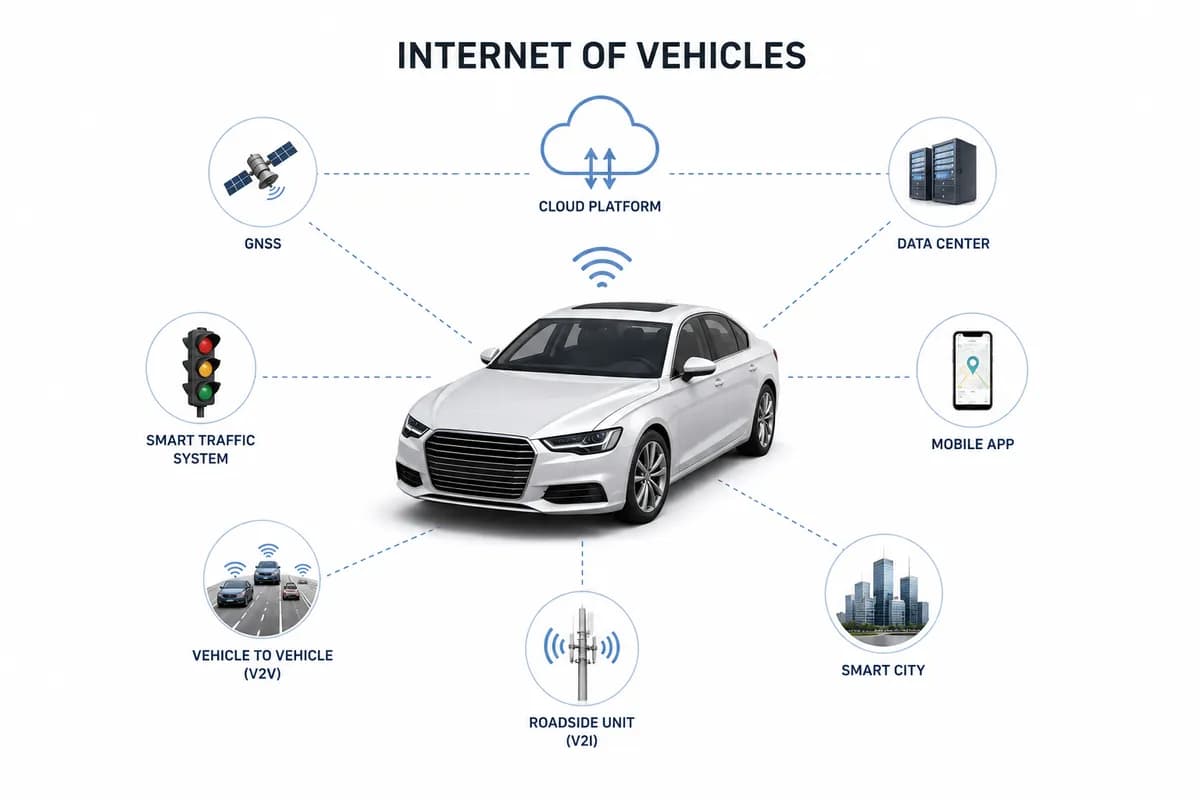
The "Device" layer acts as the sensory and execution interface, comprising in-vehicle wireless terminals (T-Box), intelligent cockpit domain controllers (CDC), and sensors. This segment represents the primary area of hardware cost concentration and the main battleground for Tier 1 suppliers like Desay SV and Foryou Corporation. The "Pipe" layer serves as the connectivity link; the focus of value creation here is shifting from standalone On-Board Units (OBU) to Roadside Units (RSU). The deployment of roadside infrastructure by companies like Wanji Technology and Genvict effectively lays "digital tracks" for the commercial vehicle IoV ecosystem. The "Cloud" layer functions as the data hub; dominated by telecom operators and cloud service providers, it handles massive, concurrent data streams.
This architecture has radically altered the flow of value. Previously, component supply followed a linear, one-way path from upstream chip manufacturers to downstream OEMs. Today, this relationship has evolved into a collaborative network: chipmakers participate directly in the early architectural design phases of automakers, while data from roadside RSUs feeds back into cockpit algorithms.
Cost Breakdown: Who Captures the Highest Premium in Hardware Systems?
Cost distribution within intelligent cockpit and connectivity systems is highly uneven. Core chips (SoC/MCU) represent a massive cost sink, accounting for 30% to 40% of the total cockpit system BOM (Bill of Materials) cost.
30–40%
Core Chips (SoC/MCU)
15–20%
Communication Modules (5G+V2X)
10–15%
PCBs and Passive Components
The market for high-end SoCs is currently a duopoly dominated by Qualcomm and NVIDIA. Take Qualcomm’s 8155 chip, for instance: its unit price has long remained in the $150–$250 range, while the newer-generation 8295 chip commands an even higher premium. This premium stems not from the silicon wafer itself, but from monopolies over advanced manufacturing processes and deep integration with software stacks. In contrast, PCBs and passive components account for only 10–15% of costs, leaving almost no room for price negotiation.
Communication modules (5G+V2X) account for a 15–20% share of costs. Quectel and Fibocom have driven down unit prices for modules through economies of scale, yet the cost of 5G modules remains three to five times that of 4G modules. Currently, 5G module prices are on a downward trajectory, dropping by approximately 15%–20% annually. This easing of prices is a prerequisite for the penetration of connected vehicle technology into mid-to-low-end vehicle models. What is truly expensive is not the plastic housing, but the advanced-process logic circuitry encapsulated within.
Certification Barriers: How the 18-Month Automotive-Grade Cycle Filters Players
The connected vehicle supply chain features an invisible "moat": a certification cycle spanning 18 to 24 months. This poses a significant hurdle for consumer electronics players attempting to cross over into the sector.
"
AEC-Q100 (reliability standard) and ISO 26262 (functional safety standard) serve as the "admission tickets" for entry. While a consumer-grade chip might require only a few weeks of testing, an automotive-grade chip must undergo thermal cycling across an extreme range of -40°C to 125°C. Consequently, for the same logic design, the production and testing costs for automotive-grade chips command a premium of three to five times that of their consumer counterparts.
This time-based barrier directly dictates the survival prospects of suppliers. Established players like NXP and STMicroelectronics leverage their first-mover advantage to lock in substantial, long-cycle orders. New domestic entrants—such as SemiDrive—must secure design-win agreements with automakers before the chip even reaches the tape-out stage; otherwise, the 18-month certification gap could easily deplete a startup's cash reserves.
Geographic Landscape: Functional Differences and Division of Labor Among Four Major Industrial Clusters
China’s connected vehicle industry has evolved into four distinct hubs of influence, each with its own specialized role:
The Yangtze River Delta Cluster (Shanghai, Suzhou, Hangzhou): The undisputed center for corporate headquarters and system integration. Foreign Tier 1 suppliers like Bosch and Continental... ...Tier 1 suppliers' China headquarters are largely located here, responsible for translating global technical standards into mass-production solutions.
Pearl River Delta Cluster (Shenzhen, Guangzhou): Leveraging advantages in the electronics supply chain, this region has become a hub for communication modules. The presence of companies like Quectel and Huawei enables the world's fastest hardware iteration speeds here.
Beijing-Tianjin-Hebei Cluster (Beijing): This region holds the "soul" of the Internet of Vehicles (IoV). Companies such as Baidu and NavInfo are concentrated in fields like algorithms, high-definition mapping, and autonomous driving software.
Chengdu-Chongqing/Wuhan Cluster: These regions have adopted differentiated strategies. Wuhan, leveraging its deep-rooted expertise in commercial vehicles, focuses on overcoming challenges related to roadside infrastructure (RSU) and connected applications in specific scenarios (such as mines and ports).
Modules and Chips: Domestic Substitution Enters a Critical Phase
The communication module market exhibits a clear duopoly. Quectel and Fibocom have captured over 50% of the global market share through massive shipment volumes. To secure a profit moat, module manufacturers are expanding into the high-precision positioning sector. RTK (Real-Time Kinematic) modules are becoming standard features in high-end connected systems. By partnering with service providers, module manufacturers aim to shift from simple hardware sales to a "hardware + service" model, thereby building technological stickiness.
Domestic suppliers are moving beyond peripheral components to challenge the domain of core IP. The rise of Horizon Robotics and SemiDrive marks the entry of domestic chips into the complex realm of SoCs. Even deeper transformations are occurring in operating systems. For a long time, underlying automotive systems were dominated by QNX; however, with the mass-market deployment of HarmonyOS and Flyme Auto, domestic operating systems are leveraging ecosystem advantages to challenge QNX's long-standing dominance in stability. When Desay SV chose to deeply integrate Horizon Robotics chips with HarmonyOS, a local supply chain completely independent of foreign technological foundations began to take shape.
________________________________________
Tier 1 Suppliers Are Losing Their Clout: The Upward Shift and Downward Rooting of IoV Procurement Power
The traditional pyramid structure of the supply chain is collapsing. In the past, Tier 1 suppliers like Bosch or Continental... Suppliers once held absolute pricing power thanks to their deep integration of underlying hardware and embedded software. Now, however, that "black box" model has been shattered.
The real issue lies in the scarcity and strategic importance of core chips. To secure initial production capacity for Qualcomm’s 8155 or 8295 chips, automakers like NIO and Xpeng have bypassed integrators to sign strategic supply agreements directly with Qualcomm. This "direct sourcing" model has rapidly diminished the role of Tier 1 suppliers. In these deals, automakers dictate the chip unit price, technical roadmap, and delivery schedule, leaving Tier 1s to handle only the subsequent hardware contract manufacturing, testing, and logistics.
This shift in power has squeezed integrators' profit margins from both directions. Upstream, they lack any bargaining power against chip giants; downstream, automakers use transparent Bill of Materials (BOM) audits to drive management and processing fees down to rock-bottom levels. Crucially, when automakers manage Tier 2 suppliers directly, Tier 1s effectively lose their say in technological evolution, becoming little more than "high-end logistics providers" within the supply chain.
The Twilight of Integrators: Contract Hardware Manufacturers or Software Partners?
In an era where value is defined by software, the boundaries of Tier 1 survival are blurring. Leading OEMs favor "full-stack in-house development" strategies, requiring Tier 1s to provide only "bare hardware"—hardware units containing basic drivers but lacking core algorithms. This means that the high-margin software integration fees—once the domain of Tier 1s—are now internalized by the automakers themselves.
Huawei’s entry as a "new-breed Tier 1" supplier has placed immense competitive pressure on traditional local players. Huawei offers full-stack solutions that include the HarmonyOS cockpit system and intelligent driving algorithms. This model forces traditional suppliers to make a choice: either transform into a comprehensive "hardware plus middleware" platform—as Desay SV has done by forging deep ties with Nvidia and Qualcomm—or remain trapped in a cutthroat race to the bottom within the low-value market for commoditized parts. Once automakers master middleware development, hardware commoditization becomes inevitable, and Tier... ...core competitiveness will devolve into extreme cost control.
The Cost of Software-Defined Systems: How Licensing Fees Reshape Profit Distribution
The structure of procurement contracts is undergoing a fundamental shift. While the focus used to be on the unit price per delivery, NRE (Non-Recurring Engineering) costs and licensing fees have now become the central topics at the negotiating table.
The QNX operating system has long dominated the underlying cockpit software market; its business model relies on a licensing fee of $5–10 per vehicle. Although the unit price is low, the economies of scale turn this "toll" into a highly stable, high-margin revenue stream. Even more noteworthy is how domestic chipmakers—such as Horizon Robotics and SemiDrive—are leveraging a "China for China" strategy to make precise inroads into joint-venture automakers. Due to geopolitical factors and data compliance requirements, automakers like Volkswagen and Toyota cannot simply transplant their global software architectures; this creates an opening for domestic suppliers to offer "chip + algorithm + toolchain" bundles, thereby capturing licensing revenue that would otherwise go to foreign software vendors.
This implies that future procurement in the connected vehicle sector will not merely involve the delivery of physical goods, but will become a contest over intellectual property (IP) rights. When paying NRE fees, automakers will strictly demand code ownership or co-ownership to avoid being "locked in" by suppliers. For procurement teams, the ability to dissect complex software licensing agreements and evaluate the Total Cost of Ownership (TCO) differences between long-term subscriptions and one-time buyouts has become a fundamental skill.
________________________________________
Reshaping Supply Resilience: Shifting from Hardware BOM Procurement to Software Licensing and Capacity Locking
Shortages of high-performance SoCs and communication basebands have become a structural norm in the connected vehicle hardware supply chain. Procurement departments must break free from the habit of placing orders based solely on immediate demand and instead sign Long-Term Agreements (LTAs) directly with original chip manufacturers.
A truly effective LTA... Agreements must incorporate provisions for advance payments, production scheduling, and price-linkage mechanisms. The key lies in establishing a "tiered capacity guarantee": during demand surges, the manufacturer prioritizes a baseline supply, while during demand slumps, the automaker commits to a minimum purchase volume. To hedge against inventory devaluation risks associated with the transition from 4G to 5G, contracts should include price adjustment clauses that link chip unit prices to the foundry's publicly listed rates.
A geopolitical risk assessment matrix should be a prerequisite for vendor selection. Regarding advanced-node chips, procurement teams need to simulate "supply disruption scenarios" and identify at least one domestic backup source for every critical SoC. ZTE’s in-house developed alternatives for communication baseband chips serve not only as a technological reserve but also as leverage at the negotiating table to drive down the price premiums charged by foreign chipmakers.
Compliance is Critical: Sourcing Guidelines for Cloud Services under Data Security Regulations
The promulgation of the *Provisions on the Management of Automotive Data Security* has placed cloud service procurement squarely within the realm of strict compliance requirements. Restrictions on multinational cloud providers regarding domestic data storage and the cross-border transfer of sensitive data have given local providers—such as Baidu, Huawei, and NavInfo—a natural competitive advantage.
Sourcing criteria must shift from a focus on "technical performance" to a focus on "data sovereignty." For operations such as OTA updates and the distribution of high-definition maps, cloud service providers must offer physically isolated private clouds or regulated... ...public cloud solutions. What is easily overlooked is that cloud service pricing models are undergoing radical change. Procurement teams should move away from traditional fixed-bandwidth billing and adopt a TCO-based SaaS model—specifically, tiered pricing based on the number of connected vehicles or active users. This approach effectively distributes operational costs across the vehicle's entire lifecycle, preventing the burden of massive idle-capacity expenses when sales volumes fall short of expectations.
IP Ownership in the JDM Model: Establishing a Contractual Framework for "Strategic Co-creation"
Traditional buyer-seller relationships can no longer keep pace with the need for rapid software iteration; consequently, the JDM (Joint Design and Manufacturing) model is becoming the mainstream approach. Automakers and suppliers—such as Horizon Robotics and SemiDrive—are moving beyond simple supply-demand dynamics to jointly develop underlying drivers and middleware.
The most complex aspect of negotiations lies in Intellectual Property (IP) ownership. Procurement managers must clearly define in contracts which code constitutes "shared IP" and which belongs to the automaker as "exclusive IP." A pragmatic strategy is to assign underlying general-purpose drivers to the supplier in exchange for lower Non-Recurring Engineering (NRE) fees, while retaining exclusive rights to application-layer algorithms that dictate user experience and driving logic.
Agreements on liability allocation serve as another critical stabilizing factor. In the event of a large-scale recall caused by a software bug, recourse mechanisms must extend beyond mere hardware replacement to cover software remediation and OTA... ...and losses related to push notifications and brand reputation. Establishing a backup system based on "domestic chips + domestic OS" is not merely about circumventing sanctions; it is also about gaining more transparent access to underlying code within the JDM (Joint Development Manufacturing) model.
Organizational Restructuring: Procurement Teams Need Negotiation Experts Who Understand Code
In the era of software-defined vehicles, the profile of ideal procurement talent is being redefined. Team members who focus solely on resistors and capacitors listed in the Bill of Materials (BOM) will be completely ill-equipped to handle negotiations regarding software licenses and service fees.
The first step in transforming the procurement team's function is to bring in sourcing experts with backgrounds in software engineering. They must analyze the reasonableness of kernel licensing fees and assess whether the software premium in a full-stack solution accurately reflects actual R&D investment. Evaluation metrics should shift from "unit cost reduction" to "software TCO (Total Cost of Ownership) analysis," encompassing factors such as ongoing maintenance and upgrades, API call fees, and system migration costs.
Supplier evaluation criteria must also incorporate "ecosystem sustainability." Licenses provided by a software vendor with financial instability or a closed ecosystem risk becoming unmaintainable "dead code" within three years. Procurement directors must act like venture capitalists, scrutinizing a supplier's R&D investment ratio and developer community activity to ensure the chosen technology stack does not become obsolete during the vehicle's full lifecycle.