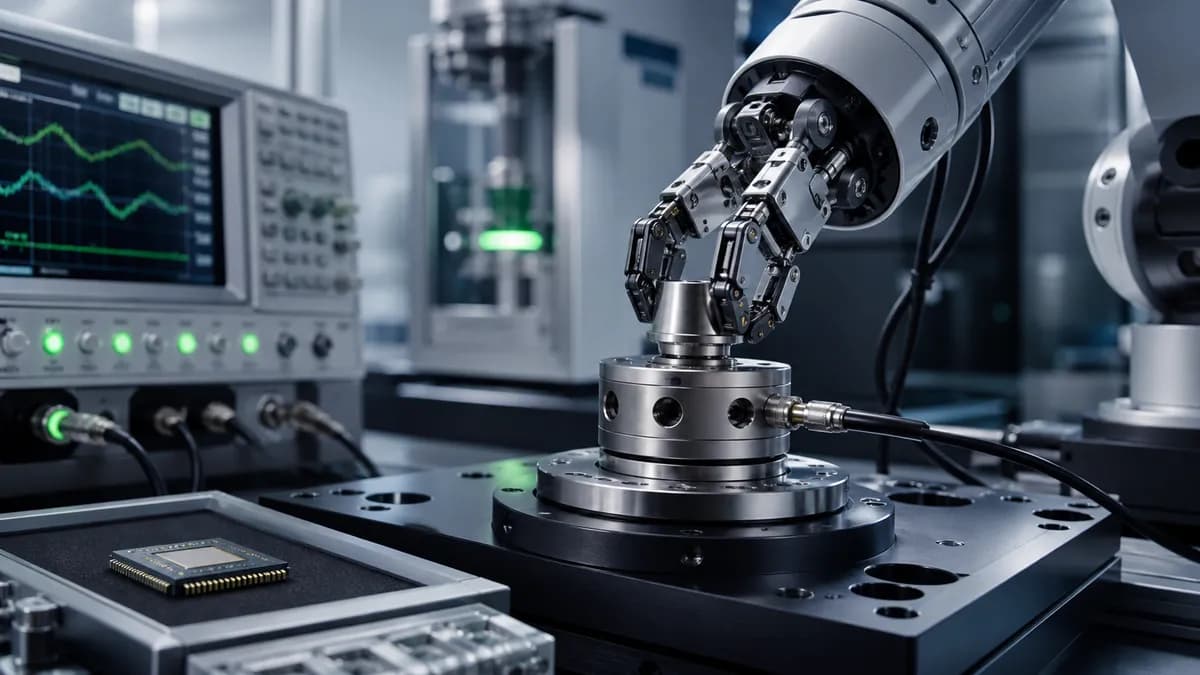
A practical view of China’s robot-sensor clusters, calibration bottlenecks, component costs, and procurement risk mitigation.
Industry Chain Overview: From Geographic Clusters to Cost Structure
Three Major Clusters: The Geographic Landscape of China's Robot Sensors
Domestic supply capabilities for robot sensors are not evenly distributed; instead, they have formed geographically distinct clusters—in the Yangtze River Delta, the Pearl River Delta, and the Beijing-Tianjin-Hebei region—driven by three main factors: precision manufacturing, supporting electronics industries, and scientific research resources. This division of labor is not the result of policy planning but rather the physical outcome of the natural evolution of industrial elements.
Centered on Suzhou, Shanghai, and Wuxi, the Yangtze River Delta cluster has established the most complete closed-loop industry chain in the country. This region hosts the regional headquarters of multinational giants like Bosch and STMicroelectronics, and serves as a major hub for domestic chip contract manufacturing and packaging/testing. Suzhou’s strength lies in its deep-rooted precision machining capabilities; a large number of local CNC workshops—which supply German and Japanese Tier 1 manufacturers—can meet the micron-level geometric tolerance requirements for the elastic bodies of six-axis force sensors. In contrast, Wuxi has achieved economies of scale in the field of MEMS (Micro-Electro-Mechanical Systems) packaging. Procurement in the Yangtze River Delta follows a "one-stop" logic: the geographic radius for everything from sensor chip design to backend precision structural components is typically under 100 kilometers.
The Pearl River Delta cluster operates at a completely different pace. Shenzhen and Dongguan are innovation hubs for 3D vision sensors and LiDAR. Their core competitiveness lies in rapid mold development and high-efficiency turnover of electronic components. Companies such as Orbbec and Hikrobot have leveraged the mature camera module supply chain in Huaqiangbei and the surrounding areas to successfully transition from consumer-grade to industrial-grade sensors. In Shenzhen, the cycle for taking a new vision sensor's structural component from blueprint to finished prototype can be compressed to just three days—a level of responsiveness difficult to match elsewhere in the world. The difference between Suzhou and Shenzhen is that Suzhou excels in "stability," making it ideal for the precision machining required by high-accuracy force sensors, whereas Shenzhen excels in "speed," making it perfect for vision sensors—electronic products characterized by rapid iteration cycles.
The Beijing-Tianjin-Hebei cluster possesses a strong "laboratory DNA." Centered on Beijing and driven by the commercialization of research findings from institutions like Tsinghua University and Beihang University, this cluster has developed unique advantages in fields—such as force sensors—that require breakthroughs in fundamental physical modeling. The technical expertise of companies like Kunwei Technology and SRI (Sunrise Instruments) has been largely shaped by the specialized demands of the aerospace sector. While these suppliers may not be distinguished by sheer scale, they command significant bargaining power due to their capabilities in non-standard customization and high-precision algorithmic decoupling.
The Cost "Black Box": Why Calibration Labor Costs More Than Raw Materials
A common misconception regarding the cost structure of robot sensors is the belief that raw materials (such as aerospace-grade aluminum or stainless steel) constitute the bulk of the expense; in reality, the "invisible" cost of labor—specifically for calibration—is the primary price driver.
>30%
Manual calibration and data compensation
25–30%
Precision CNC machining of the elastic body
20–25%
Core components (strain gauges/ADCs)
Take the six-axis force sensor as an example: its cost structure is characterized by high costs at both ends and lower costs in the middle. Manual calibration and data compensation account for the largest share—over 30%—of the total cost. These sensors cannot simply be used immediately after assembly; they must undergo thousands of load tests on high-precision calibration rigs to establish the mapping between raw electrical signals and actual applied force. Due to inherent inconsistencies in the machining of the elastic body, every single sensor requires individual calibration. This "one-unit, one-calibration" model creates a production bottleneck and prevents the kind of cost dilution achievable through the automated assembly lines used in chip packaging and testing.
Critical Gaps: Reliance on Imported High-Precision Strain Gauges and MEMS Chips
Despite the year-on-year rise in domestic production rates, significant technical hurdles remain at the upstream end of the supply chain. High-precision strain gauges serve as the "retina" of force sensors; currently, the domestic high-end market is virtually monopolized by Vishay (USA) and Nakajima (Japan). While domestic strain gauges perform comparably to international standards at room temperature, gaps remain regarding temperature compensation consistency and long-term creep characteristics. For humanoid robots, sensors must maintain accuracy amidst complex temperature fluctuations. Consequently, R&D teams tend to be extremely conservative in their component selection, preferring to pay a premium and accept lead times exceeding 12 weeks rather than risk switching to domestic alternatives that lack long-term performance validation. High-end MEMS chips represent another sector where domestic players face significant challenges. Whether in high-precision gyroscopes for balance control or pressure array chips for tactile sensing, companies like ST, Bosch, and InvenSense continue to dominate. While domestic manufacturers such as Xindong Lianke are beginning to scale up production of industrial-grade IMUs (Inertial Measurement Units), the failure rate (FIT) metrics for high-end automotive-grade and robotics-specific models still require validation through extensive real-world operational data.
Competitive Landscape: From Keyence’s Monopoly to Breaking Out of the "Red Ocean" in Domestic Vision Modules
The global robotics sensor market is undergoing a dramatic shift in power dynamics. In the high-end segment, global Tier 1 suppliers—such as Keyence, ATI, and Cognex—maintain a formidable competitive moat built on decades of accumulated patents and strong brand premiums.
Vision Sensors
Breaking Out of the "Red Ocean"
With the entry of security giants like Hikvision and Dahua, hardware prices have plummeted; these devices have shifted from being classified as "precision instruments" to "commodity electronic components," and the focus of competition has moved toward underlying algorithm libraries and system compatibility.
Force Sensors
One Dominant Player and Several Strong Contenders
US-based ATI was once synonymous with the category, but a domestic cohort—led by companies like Kunwei Technology and SRI (Yuli Instruments)—is rapidly capturing market share through cost-effectiveness and customized services characterized by close, hands-on support.
In the domestic force sensor arena, Kunwei Technology and SRI represent two distinct evolutionary paths. SRI possesses a deep industrial heritage, with a track record of extensive deployment in extreme environments such as automotive crash testing and aerospace engine test stands; its strengths lie in "heavy-duty" capabilities and standardization. In contrast, Kunwei Technology operates more like an "algorithm-driven" hardware company; its core team hails from an aerospace background, placing it at the forefront of sensor lightweighting and digital output technologies. This technology-driven competition, tailored to specific application scenarios, is replacing simple price wars as the primary driver for domestic sensors to move up the value chain.
Calibration Capacity—Not Chip Shortages—Is the Hidden Fatal Flaw for Scaled Delivery of Humanoid Robots
An Overlooked Bottleneck: Calibration Benches Determine the Ceiling for Mass Production
In conventional supply chain thinking, chip shortages or rising raw material costs are viewed as the primary obstacles to delivery. However, within the supply ecosystem for six-axis force sensors, the physical constraint that truly limits delivery scale is the output efficiency of calibration benches.
"
Even if a supplier secures an ample supply of strain gauges and amplifier circuits, the production line will still stall if there are insufficient downstream calibration benches.
Calibration equipment itself is a non-standard asset with extremely high barriers to entry. To ensure the precision of six-axis force decoupling, a calibration bench requires loading accuracy and stability an order of magnitude higher than the sensor being tested. Currently, most leading sensor manufacturers utilize self-developed calibration equipment. This investment model—characterized by heavy assets and long cycles—results in a distinct "step-function" effect regarding capacity expansion. As humanoid robot orders scale up from the hundreds to the tens of thousands, buyers discover that the supplier's greatest risk is not a chip shortage, but rather hitting the ceiling of daily calibration bench output.
The Shift in Bargaining Power: Why Vision Sensors Are No Longer Profitable
The profit structure of the robot sensor market is undergoing a dramatic divergence. On the surface, vision sensors (2D/3D cameras) serve as the robot's "eyes" and hold a pivotal position. In reality, however, with the horizontal market entry of security giants like Hikrobot and Huaray Technology, the hardware gross margins for vision modules have been diluted to levels typical of traditional electronics manufacturing.
Vision Sensors
Commodity-like Components
Highly standardized and interchangeable across brands; bargaining power rapidly shifts toward the buyer.
Force Sensors
High-Stickiness Components
Hardware and software are tightly integrated with deeply optimized control algorithms; suppliers retain significant bargaining power.
Deep Coupling: Why Sensor Specifications Must Be Finalized During the Prototype Stage
In consumer electronics, procurement teams can switch inductor or capacitor suppliers right before mass production by comparing prices. In the robotics R&D process, however, switching sensor suppliers mid-stream... ...switching suppliers is tantamount to suicide. Sensor data feedback directly impacts the stability of the dynamic model. Replacing the established ATI sensor with a domestic alternative could force the R&D team to overhaul the entire control law and spend months re-running gait simulations and fine-tuning the physical robot. This "component selection debt" would exact a heavy toll through exorbitant migration costs and delivery risks.
Technological Singularity: Can Visual AI Completely Replace Physical Pressure Sensing?
The competitive moat protecting traditional force sensors is not impregnable; a disruptive challenge from visual AI is looming. Technologies like GelSight—which use vision to emulate tactile sensing—offer a novel approach: capturing the deformation of a flexible contact surface via camera and using deep learning to infer the magnitude and distribution of applied force. The appeal of this solution lies in its ability to transform expensive, precision mechanical measurement into low-cost image processing. However, the ultimate stronghold of physical sensors remains their superior response frequency and reliability in extreme environments. The future supply chain for robot sensing will likely adopt a dual structure: visual AI handling low-frequency, broad-range perception, while physical sensors manage high-frequency, precision feedback.
From Relationship-Based Purchasing to Technical Strategy: A Risk-Mitigation Guide for Robot Sensor Procurement
Strategic Stockpiling: Inventory Strategies for 12–20 Week Lead Times
In the realm of robot sensors, procurement teams must face a harsh reality: the supply elasticity for high-precision strain gauges and core FPGA chips is virtually zero. Currently, lead times for high-end strain gauges from Vishay (USA) and automotive-grade processing chips from STMicroelectronics (ST) consistently hover between 12 and 20 weeks.
12–20 Lead Times for Core Components
The only truly effective risk-mitigation strategy is to initiate a 6-to-12-month strategic stockpiling plan for core materials. This is not a matter of blind hoarding, but rather an approach based on a classification model that categorizes materials by risk level. For irreplaceable components that cannot be bypassed through algorithmic solutions—such as Bosch’s high-performance gyroscopes—inventory levels should cover two full R&D iteration cycles.
The ESI Model: Why Procurement Must Participate in R&D Prototyping
In robotics R&D, the costliest errors usually arise from material substitutions made after the design has been finalized. Sensor selection is deeply coupled with the control system's dynamic models. Consequently, the ESI (Early Supplier Involvement) model is no longer merely an option; it is the procurement team's ticket to the core of the R&D process. During the prototyping phase, the procurement manager’s critical task is to prevent R&D from selecting "lab-only" components—items available only in isolation—and to mandate the introduction of domestic alternatives for parallel validation. This ensures that, should restrictions affect core imported components, a "hot-swappable" alternative is ready for immediate deployment.
Localization Roadmap: The Rollout Schedule from Vision Modules to High-Precision IMUs
Domestic substitution should not be a campaign rolled out across the board; instead, it should be... ...proceeding through a phased integration within the "risk-return" matrix. The current consensus follows the sequence: "vision first, force sensing to follow."
Step 1: Vision First
Vision modules have achieved the highest level of domestic localization; solutions from companies like Will Semiconductor and Hikrobot already cover most application scenarios. Procurement focuses on leveraging price transparency to reduce costs.
Step 2: Force Sensing to Follow
The substitution of core components—such as IMUs and six-axis force sensors—requires greater caution. Supply chain autonomy and control should be gradually increased through a phased rollout, starting with trials in non-critical joints and data benchmarking.
Algorithm Evaluation: How to Assess a Supplier's Software Delivery Capabilities?
In the procurement list for robot sensors, hardware represents only the tip of the iceberg; the SDKs and decoupling algorithms beneath the surface are what truly determine whether the control system can utilize the data. Procurement teams need to establish an assessment system based on software delivery capabilities. The primary metric is the compatibility and maturity of ROS (Robot Operating System) drivers. If a supplier cannot provide robust ROS/ROS2 interfaces, any hardware cost advantages will be quickly negated by the subsequent R&D man-hours required. A truly resilient supply chain does not prioritize absolute low prices, but rather "supply continuity" under extreme conditions.